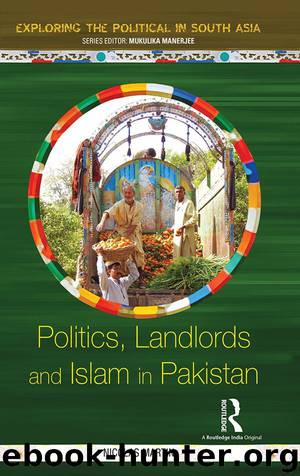
Politics, Landlords and Islam in Pakistan (Exploring the Political in South Asia) by Nicolas Martin
Author:Nicolas Martin [Martin, Nicolas]
Language: eng
Format: epub
ISBN: 9781138821880
Amazon: 1138821888
Publisher: Routledge India
Published: 2015-10-15T19:00:00+00:00
Despite the fact that several authors invoke kinship to explain the failure of political parties to establish roots in Pakistan, few really examine how it actually determines people’s political allegiances.
As Wilder’s quote above indicates, extended biraderis – like the Gondal biraderi – tend to be divided into factions and rarely act as a united political unit by for example voting as a block. Unlike in segmentary systems (most commonly used by scholars to analyse Middle Eastern tribal society)2 where feuding agnates leave their rivalries aside and unite in the face of external aggression, the Gondals – like Fredrik Barth’s Khans – frequently aligned themselves with outsiders against their own clan members and even their close kin. In the classical segmentary model (most commonly used by scholars to analyse Middle Eastern tribal society) the presence of shared interests in a joint estate, together with a sense of honour attached to the tribe, cause opposed segments at one level of segmentation to unite at a higher level of segmentation when faced with an external threat. In such a scenario it might be expected that, despite their internal quarrels, Gondals would always support a Gondal politician over and above a politician belonging to another biraderi since to support an outsider would undermine the interests of the biraderi as a whole.
The empirical evidence presented in this chapter does not support the view that the extended biraderi is the principal building block of political activity in the Punjab. Instead it will be argued that factions characterised by ‘a vertical structure of power which cross-cuts caste and class divisions’ (Brass 1965: 236), and which are based upon a loose coalition of individuals united by common enmities and structured around a closely knit kinship based core, are the principal building blocks of political activity and allegiance.3 Following Barth in ‘Segmentary Opposition and the Theory of Games’ (1981), this chapter presents the argument that, even if it is possible to talk of members of an extended biraderi sharing in a joint estate, this possibility ‘need not imply a community of interests, and may in fact imply an overriding opposition of interests which inhibits the emergence of corporate unity’ (Barth 1981: 81). Barth argues that amongst the Swat Pathans it is the overriding opposition between patrilateral cousins (tarbur), who almost invariably compete over the possession of land and the control of client groups implied by it, which inhibits the emergence of the corporate unity of the Yusufzai Pathans. According to Barth’s model, a Pakhtun’s ‘political activities are directed at gaining an advantage over his agnatic rivals, as only through their defeat can he achieve his own aggrandizement’ (Barth 1981: 67). To this end agnates make political alliances with distant collaterals against each other and follow the principle that the enemy of their enemy is their friend. Barth argues that the principal reason why Pakhtuns can afford to oppose their agnates is that, unlike in other lineage systems, their agnates do not form the bulk of their supporters. Instead the
Download
This site does not store any files on its server. We only index and link to content provided by other sites. Please contact the content providers to delete copyright contents if any and email us, we'll remove relevant links or contents immediately.
| Africa | Americas |
| Arctic & Antarctica | Asia |
| Australia & Oceania | Europe |
| Middle East | Russia |
| United States | World |
| Ancient Civilizations | Military |
| Historical Study & Educational Resources |
Cecilia; Or, Memoirs of an Heiress — Volume 1 by Fanny Burney(32561)
Cecilia; Or, Memoirs of an Heiress — Volume 2 by Fanny Burney(31958)
Cecilia; Or, Memoirs of an Heiress — Volume 3 by Fanny Burney(31944)
The Secret History by Donna Tartt(19098)
Sapiens: A Brief History of Humankind by Yuval Noah Harari(14392)
Leonardo da Vinci by Walter Isaacson(13339)
The Radium Girls by Kate Moore(12033)
Sapiens by Yuval Noah Harari(5374)
How Democracies Die by Steven Levitsky & Daniel Ziblatt(5223)
The Wind in My Hair by Masih Alinejad(5100)
Homo Deus: A Brief History of Tomorrow by Yuval Noah Harari(4922)
Endurance: Shackleton's Incredible Voyage by Alfred Lansing(4786)
Man's Search for Meaning by Viktor Frankl(4608)
The Silk Roads by Peter Frankopan(4537)
Millionaire: The Philanderer, Gambler, and Duelist Who Invented Modern Finance by Janet Gleeson(4481)
The Rape of Nanking by Iris Chang(4218)
Joan of Arc by Mary Gordon(4116)
The Motorcycle Diaries by Ernesto Che Guevara(4105)
Stalin by Stephen Kotkin(3971)
